19Feb 2026
Tribute to José Álvaro Moisés
15:38 - By Brigitte Weiffen
To the IPSA community,
It is with deep regret that we inform you of the passing of José Álvaro Moisés.
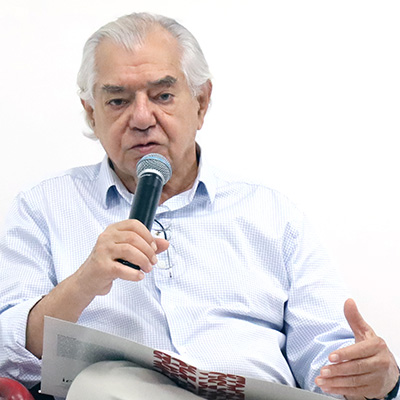
José Álvaro Moisés (1945 – 2026), former chair of our RC 34 – Quality of Democracy (2012 – 2016), was one of those rare scholars whose intellectual work cannot be separated from a lived commitment to democratic life.
His public trajectory helps illuminate the successive phases of his academic production. In the years when Brazilian democracy was still a horizon rather than an institution, Moisés combined scholarly enquiry with political engagement, participating in the founding cycle of the Partido dos Trabalhadores (PT) in 1980 and contributing to the broader ecosystem of democratic opposition and reconstruction. That early experience shaped a lifelong interest in the relationship between popular organisation, representation, and the quality of democratic institutions - an interest that later acquired its most systematic form in his work on political culture, legitimacy, trust, and institutional performance.
In the same formative period, his political vocation was inseparable from a generational militancy against the Brazilian dictatorship. As a young intellectual, he was part of the democratic struggle that unfolded through universities, civic networks, and emerging spaces of critical reflection. He joined and helped animate the milieus around CEBRAP (Brazilian Centre for Analysis and Planning) and CEDEC (Centre for Studies of Contemporary Culture), institutions that, in different ways, sustained rigorous social science under authoritarian constraints and then became key laboratories for thinking through democratisation. This experience left a durable imprint on his scholarship, it anchored his insistence that democracy is not simply an institutional arrangement, but a historical achievement built through organisation, conflict, and learning, and therefore always vulnerable to reversal.
As a communicator, Moisés insisted that political science had responsibilities beyond the academy. With strong involvement in journalistic media, he moved between scholarly production and public debate, writing, speaking, and explaining politics to wider audiences as part of a civic vocation. He never treated democracy as a purely normative ideal, but as something that must be continuously sustained by institutions that work, citizens who recognise themselves in those institutions, and elites who accept democratic limits even when they lose.
In intellectual terms, his earlier scholarship fed directly into later questions about democratic consolidation. As Brazilian politics moved from transition to institutional routine, Moisés pushed beyond the celebratory narratives that sometimes accompany democratisation. He asked, instead, what kinds of democratic experience were being produced in practice: how far representation was integrating citizens; what patterns of inclusion and exclusion were stabilising; and how the architecture of institutions interacted with deeper orientations of political culture. This insistence on connecting institutional design to lived legitimacy would become one of the signature threads of his work.
A crucial dimension of his public service came through cultural policy. During Fernando Henrique Cardoso’s government, Moisés served at the Ministry of Culture, including as Executive Secretary and as National Secretary for Audiovisual. His passage through MinC did not sit apart from his academic trajectory, it gave concrete form to questions he pursued with conceptual discipline, like how public policy is designed and implemented, how institutions mediate rights and access, and how culture operates as both a field of symbolic production and a domain of citizenship.
Over time, that thread crystallised into a research programme on quality of democracy, a programme he pursued not only in Brazilian academic institutions but also through international scholarly governance. His engagement with the International Political Science Association (IPSA) was constitutive. Moisés served on IPSA’s Executive Committee (2012 - 2014) and later represented IPSA internationally when he was elected in October 2013 to replace Helen Milner as IPSA’s representative to the International Social Science Council (ISSC) for the 2014 – 2016 period. In parallel, he worked to build durable platforms where debates about democracy’s quality could be pursued comparatively, empirically, and with methodological pluralism.
That institutional labour culminated in one of RC34’s defining moments. Inspired by Leonardo Morlino (IPSAS` President at that time), José Álvaro Moises and Marianne Kneuer founded RC 34 – Quality of Democracy, launched at the IPSA World Congress in Madrid in 2012. In the committee’s first business meeting Moisés was unanimously elected Chair, signalling both recognition of his scholarly leadership and confidence in his capacity to make a new research committee thrive. Less than a year after the passing of Morlino, this earlier co-creation now reads not only as an organisational achievement but as an intergenerational legacy, a global scholarly infrastructure devoted to understanding, with seriousness and robustness, how democracies operate, and how to defend and strength democracy around the world.
The thematic arc of Moisés’ scholarship maps closely onto the successive challenges of Brazil’s democratic trajectory, while remaining legible to comparative research. In the consolidation era, he gave particular attention to the socio-political bases of democratic legitimacy and to how citizens interpret the idea of democracy itself, questions that naturally led into his later, widely cited work on political trust and distrust. The central puzzle was not merely whether citizens liked or disliked particular governments, but how they evaluated institutions as such; why distrust became durable, how it shaped participation and representation, and what it did to the functioning of democratic regimes. His edited volumes and research leadership treated distrust not as a moral diagnosis but as an empirical object, measurable, historically rooted, and politically consequential.
In the last phase of his production, the same research programme acquired renewed urgency as democratic politics worldwide entered a period of heightened conflict, polarisation, and contestation of democratic norms. Moisés followed this shift with characteristic clarity. He connected crises of representation to transformations in political communication, to the erosion of institutional credibility, and to the rise of leaders and movements willing to treat democratic constraints as obstacles rather than foundations. In doing so, he helped show how “quality of democracy” cannot be reduced to a single indicator or institutional checklist. Further, it is a moving equilibrium between procedures, cultural policy, rights, and legitimacy, each capable of corroding the others.
What makes Moisés’ trajectory especially significant now is precisely that he never allowed democracy to be understood only as a set of minimal procedures. In our contemporary moment, democracy is being questioned simultaneously at two levels. At the most minimalist level, we see disputes over elections, over the acceptance of results, and over the norms and practices that make the transition of power peaceful, routine, and legitimate. At the highest level of democratic aspiration, we see intensified contestation over the very meaning of freedom and equality - over who counts, who belongs, whose voice is recognised as authoritative, and which lives are deemed compatible with the public good.
Personalities like José Álvaro Moisés matter because they bridge those levels without collapsing one into the other. His trajectory reminds us that the defence of elections and institutional continuity is necessary but insufficient; and that commitments to freedom and equality require institutional forms robust enough to carry them through moments of fear, and polarisation. Moisés’ life - in scholarship, in political engagement, and in public communication - stood for a simple, demanding proposition: democracy’s quality is never guaranteed, but it can be studied, debated, and strengthened. RC 34 - Quality of Democracy carries this DNA, and all its members work tirelessly to understand democracy and how it works, contributing to the improvement of democracies around the world in a thorough and objective manner.
José Veríssimo Romão Netto
Chair, RC 34 – Quality of Democracy